

 English
 Español
 عربى
عربى Get a Quote
The Critical Role of Lubrication Balance in High-Speed Pipe Extrusion
In rigid PVC pipe manufacturing, extruder output depends as much on thermal stability as on the frictional behavior of the melt. A stabilizer must control degradation while precisely managing metal release and melt viscosity. At JiangSu Uniwel Chemistry, our Lead Based One Pack Heat Stabilizer for PVC Pipes is designed with a multi-component lubricant system that synchronizes external slip (paraffin waxes, oxidized polyethylenes) with internal lubricants (fatty acid esters, calcium stearate). This synergy prevents excessive shear heating during high screw speeds and eliminates plate-out on calibration sleeves.
How One-Pack Systems Simplify Formulation
- Pre-dispersed lubricants reduce the risk of weighing errors that cause surging or melt fracture.
- Optimized fusion time ensures uniform plastification across thick and thin pipe walls.
- The single-pack format eliminates on-site mixing of multiple additive powders, improving workplace cleanliness.
Pipe producers often observe that unbalanced lubrication leads to diameter fluctuations and longitudinal weld-line weaknesses. A well-tuned one-pack stabilizer can sustain line speeds above 20 m/min for 110 mm diameter pipes while keeping amperage draw stable. We recommend a torque rheometer evaluation to map the fusion curve against the actual extruder profile, ensuring the external/internal lubricant ratio aligns with the screw compression ratio and die geometry.
Flake Morphology: A Key Driver for Dispersion and Resin Compatibility
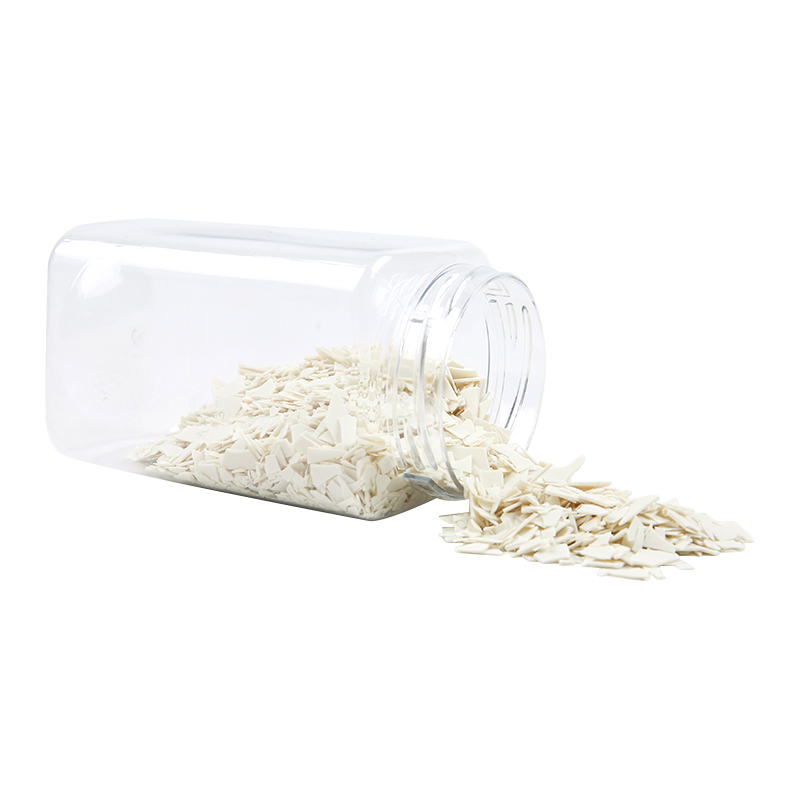
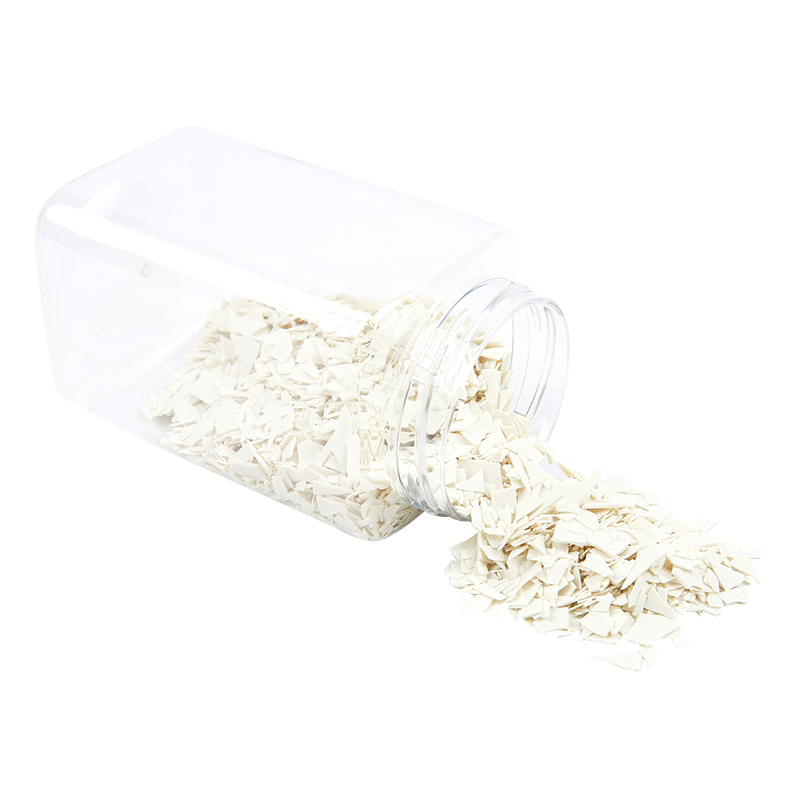
The physical form of a stabilizer directly impacts how evenly it distributes within the PVC dry blend. While powders can segregate or create dust clouds during pneumatic conveying, the compacted flake form addresses these challenges. As a China Supplier of Lead Based Stabilizer for PVC Pipes, JiangSu Uniwel Chemistry engineers its flakes to match the particle size distribution of suspension PVC resin. This similarity in bulk density and flow properties guarantees that the stabilizer does not demix during silo storage or hopper feeding.
Measurable Benefits of the Flake Architecture
- Near-zero dust generation reduces lead exposure and keeps compounding areas cleaner.
- Gentle melting of flakes during heating promotes a homogeneous melt pool, improving fusion torque consistency.
- Enhanced wetting of the resin particle surface raises the efficiency of the stabilizer, contributing to better impact resistance and tensile elongation in the finished pipe.
Optimal dispersion is the first line of defense against micro-crack propagation in pipes subjected to fluctuating internal pressure. By eliminating stabilizer-rich or stabilizer-poor domains, flake-based systems help maintain consistent heat history across the extrudate cross-section.
Comparative Weathering Resistance: Lead-Based vs. Alternative Stabilizer Systems
Outdoor PVC pipes—whether used in irrigation, guttering, or above-ground conduit—face UV radiation, thermal cycling, and moisture. These factors attack the polymer matrix, typically manifesting as chalking, pinking, or impact strength decay. Our Lead Based One Pack Heat Stabilizer for PVC Pipes incorporates antioxidants and UV screening co-stabilizers that retard photodegradation while preserving the initial color brilliance.
| Stabilizer System | Color Shift (ΔE) after 3000h Xenon Arc | Charpy Impact Retention (%) |
|---|---|---|
| Lead-based one pack | 1.8 | 92 |
| Ca-Zn composite | 4.5 | 78 |
| Organic-based system | 6.2 | 65 |
For pipes installed in high-UV environments, lead-based one pack formulations consistently deliver the lowest color drift and the best long-term mechanical integrity. The encapsulated chloride scavenging mechanism inherent to lead stabilizers remains active over decades, significantly delaying the onset of autocatalytic dehydrochlorination compared to early-generation Ca-Zn alternatives.
Maximizing Shelf Life: Proper Storage of Lead-Based One Pack Stabilizers
Although Lead Based Stabilizer for PVC Pipes is inherently less hygroscopic than some zinc-based systems, its flake form can still adsorb ambient moisture if stored incorrectly. Moisture uptake leads to agglomeration, erratic metering in gravimetric dosing units, and the formation of surface defects—such as silver streaks or micro-porosity—during extrusion.
Recommended Storage Conditions
- Keep the product in a dry, well-ventilated warehouse away from direct sunlight and steam traps.
- Maintain ambient temperature between 10°C and 35°C; avoid stacking pallets against exterior walls where condensation forms.
- Always reseal partially used bags or transfer the contents to a moisture-tight hopper with a desiccant vent.
JiangSu Uniwel Chemistry supplies its lead-based stabilizers in 25 kg multi-wall paper bags with an inner polyethylene liner, designed to block humidity during overseas shipping and warehousing. A simple squeeze test of the flakes can indicate moisture intrusion—if flakes no longer crumble freely, pre-drying at 60°C is advised before production. Even when the stabilizer appears dry, a yearly sieve analysis and moisture content check (Karl Fischer titration) can preempt costly downtime caused by blocked vacuum loaders or bridging in the extruder feed throat.


